
Antique Chinese and Japanese Porcelain collector's help and info page

GLOSSARY

Famille rose enamel decoration

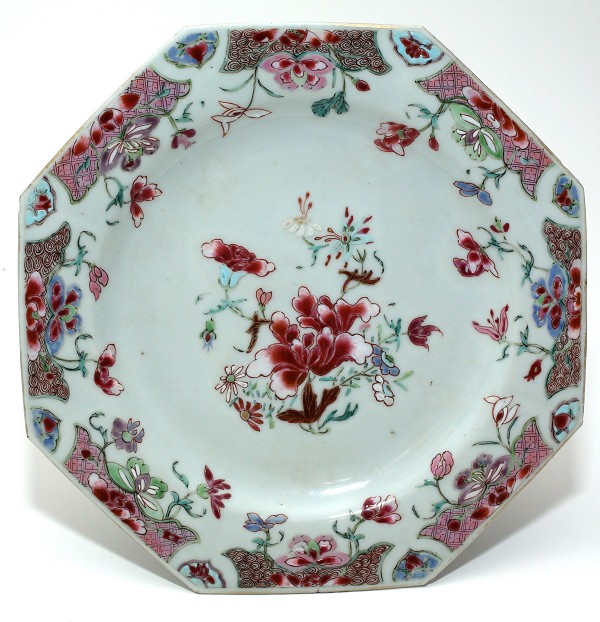
Octagonal plate decorated in "Famille rose" enamels. Diameter 22 cm. Yongzheng period (1723-35).
Photo © Jan-Erik Nilsson, Coll., 2022

Meaning "the pink family". Famille-rose enamels were first introduced around the end of the 1720's for use on porcelain. The best quality famille-rose export wares date from the Yongzheng period (1723-1735). The majority of the enamels is opaque or semi-opaque and does not flow when fired. The palette takes its name from a rose-colored enamel which makes up a characteristic color in the palette. Other significant colors in this palette are opaque yellow and opaque white.

The palette seems to have been developed with influence from European taste and demand and with technology imported via Jesuits working within the Imperial palace in Beijing.

In the last years of the Kangxi reign, foreign rouge-red oxide based enamels was used to color flower petals. This started a trend toward a new palette (known in the West as famille rose) during the succeeding Yongzheng and Qianlong reigns. In Europe and foremost France, the emerging rococo fashion, being an important export market also called for softer colors in the decorations.

The famille rose is characterized by that an opaque glassy white (bo li bai) enamel (lead arsenate) is employed as the base for coloring garments or flower petals and that colored enamels are either mixed with white or brushed on top of it to created variations in tone. Typically the earlier enamels in this palette was applied with glue as its base which helped with building thick layers of enamels, while later versions are applied with the use of rue oil as a medium, which gives thinner layers.

Compared with the transparent famille verte enamels of the previous Kangxi period (kangxi wucai) this new opaque palette could be fired at a lower temperature and had a wider color range. It also appeared softer and gentler, hence its other name ruan cai (soft colors).

During the Yongzheng reign, famille rose wares reached their zenith, replacing the famille verte of the Kangxi reign and becoming the dominate palette in overglaze decoration.

During the Qianlong reign, new techniques continued to develop. Typically the details of the decoration was filled in within outlines rather than 'boneless'. More colors began to appear as the background. The decoration was painted not only on a white transparent porcelain glaze but also on colored backgrounds such as yellow, blue, pink, coral red, light green, 'cafe au lait' and (Batavia) brown, etc. The designs also grew increasingly complex.

In the Yongzheng reign it was known as ruancai (soft colors). In the Qianlong reign it acquired the name yangcai (foreign colors), possible since this new decorative technique used many imported materials, and its method of mixing pigments was also 'foreign' however, it could also refer to the popularity abroad these gaudily decorated wares had with the export markets, which by and by overtook the market for the plain blue and white wares.

Fencai (powder colors) is a 19th C term which has been further defined to being 'famille rose decor against a white ground' whereas 'falangcai' has become the name for 'famille rose on a colored ground'. Most likely 'falang' is a Chinese pronunciation of 'foreign' while 'cai' just means 'enamels'.

Definition and technical scope

Famille rose refers to a group of Chinese overglaze enamel decorations developed during the early Qing dynasty, around 1720, and characterized by the use of opaque pastel enamels. Technically, famille rose is based on low temperature lead rich glass enamels applied over an already glazed porcelain body and fired in a secondary low temperature firing.[1]

Unlike underglaze decoration, famille rose enamels are not absorbed into the glaze but fuse onto its surface as a thin glassy layer.

Basic structure of famille rose enamels

Each famille rose enamel consists of three essential components, a glass matrix, a colorant, and an opacifier. All three are required to achieve the characteristic visual and physical properties of the decoration. [2]

Glass matrix and the role of lead

The carrier of the enamel color is a lead silicate glass. This glass was made by melting lead oxide together with silica and small amounts of alkali materials, typically potassium or sodium compounds. Lead oxide lowers the melting temperature, improves flow and adhesion, and gives brilliance and depth to the finished enamel.[3]

Lead is therefore an essential component of famille rose enamels and cannot be omitted without fundamentally changing the firing temperature and optical properties of the enamel.

Preparation of enamel frit and crushed glass

The raw materials were first melted together to form a homogeneous glass. This molten glass was quenched in water to produce a brittle material known as frit, which was then crushed and ground into a very fine powder.

When historical sources refer to crushed glass, they describe this purpose made enamel frit rather than ordinary glass. Pre melting ensured chemical uniformity, predictable melting behavior, and stable color development during firing.[4]

Coloring agents

Color was produced by adding small amounts of metal oxides or metallic compounds to the enamel frit. Typical colorants include copper for greens and some reds, iron for yellows and browns, cobalt for blue, and manganese for purples and blacks.[5]

The distinctive pink tones that define famille rose were produced using gold based colorants, often derived from colloidal gold compounds introduced to China through Jesuit mediated technology transfer in the early eighteenth century.[6]

Chromium based colorants do not belong to the traditional Qing dynasty palette and appear only in later nineteenth and twentieth century productions.

Opaque white enamel and pastel colors

The key technical innovation of famille rose decoration is the use of opaque white enamel. This white was most commonly produced using arsenic oxide as an opacifier, though tin based whites were also known.

During firing, arsenic compounds generate microscopic bubbles within the glassy enamel layer. These bubbles scatter light, producing opacity. By mixing colored enamels with white enamel, painters could create pastel tones, subtle shading, and naturalistic flesh colors not possible with earlier transparent enamels such as those used in famille verte.[7]

Preparation of the porcelain surface

Famille rose enamels were applied only after the porcelain body had been fully glazed and high fired. The surface was cleaned and sometimes lightly abraded to ensure good adhesion. Enamels were not applied to biscuit porcelain within this decorative system.

Outlining and drawing

Decorative outlines were typically applied first. These outlines were executed using iron or manganese based black enamels, and sometimes cobalt blue. They served as visual guides and as physical barriers preventing colored enamels from flowing into adjacent areas during firing.

Depending on workshop practice, outlines could be lightly fired before filling or left unfired until the main enamel firing.

Mixing and application of enamels

Enamel powders were mixed with water and sometimes small amounts of organic binders such as plant gums or animal glue. White enamel was added in carefully controlled proportions to adjust opacity and tonal value.

Application generally followed a sequence beginning with larger color fields, followed by shading and modeling, and finishing with fine details. The ability to blend tones while wet allowed a painterly approach resembling ink or watercolor techniques.

Firing process

After application, the object was fired in a muffle kiln at approximately 750 to 850 degrees Celsius. The firing atmosphere was oxidizing, and heating and cooling were carefully controlled. This temperature range was sufficient to melt the lead glass enamel without disturbing the underlying glaze.

Multiple enamel firings were common, particularly when gold decoration was included.

Use of gold

Gold was applied as a separate enamel, often after the main enamel firing. It usually required an additional low temperature firing to fix the gold to the surface. Wear or loss of gold is therefore common on surviving pieces.

Technical summary

Famille rose enamels are finely ground lead silicate glass frits colored with metal oxides and lightened with opaque white enamel, most often arsenic based. They were applied over an already glazed porcelain surface and fused in low temperature muffle kiln firings. References to crushed glass describe a deliberate pre melted enamel material rather than an improvised substitute for lead oxide.

Footnotes

[1] Kerr, Rose, and Nigel Wood, Science and Civilisation in China, Volume 5, Chemistry and Chemical Technology, Part 12, Ceramic Technology, 2004.

[2] Wood, Nigel, Chinese Glazes: Their Origins, Chemistry and Recreation, 1999.

[3] Kingery, W. D., Bowen, H. K., and Uhlmann, D. R., Introduction to Ceramics, 1976.

[4] Tite, Michael S., Freestone, Ian C., and Meeks, Nigel D., scientific papers on Chinese ceramic technology, published 1980s to 2000s.

[5] Hatcher, J. A., technical studies on Chinese overglaze enamels, published in archaeological science journals, late twentieth century.

[6] Kerr, Rose, Chinese Ceramics: Porcelain of the Qing Dynasty 1644 to 1911, 1986.

[7] Wood, Nigel, laboratory reconstructions of Qing dynasty enamel systems, published experimental work associated with the Ashmolean and Needham Research Institute.

Laboratory and kiln relevant sources

Rose Kerr and Nigel Wood, Science and Civilisation in China, Volume 5, Chemistry and Chemical Technology, Part 12, Ceramic Technology, Cambridge University Press, 2004. The standard reference for Chinese ceramic materials, kiln technology, glaze chemistry, and overglaze enamel systems, including lead based enamels and arsenic opacification.

Nigel Wood, Chinese Glazes: Their Origins, Chemistry and Recreation, University of Pennsylvania Press, 1999. Detailed chemical analysis and experimental recreation of Chinese glaze and enamel systems, including lead silicate glasses and low temperature firing behavior.

W. David Kingery, H. K. Bowen, and Donald R. Uhlmann, Introduction to Ceramics, John Wiley and Sons, 1976. Foundational materials science reference for glass and ceramic systems, including lead glass chemistry, fritting, devitrification, and thermal behavior relevant to enamel technology.

Michael S. Tite, Ian C. Freestone, and Nigel D. Meeks, scientific studies on Chinese ceramics, Published in Archaeometry and related journals, 1980s to 2000s. Laboratory based compositional analysis of Chinese glazes and enamels using SEM, XRF, and other analytical techniques, including lead, arsenic, and flux behavior.

Rose Kerr, Chinese Ceramics: Porcelain of the Qing Dynasty 1644 to 1911, Victoria and Albert Museum, 1986. While museum oriented, this work includes technically reliable summaries of enamel development, firing practice, and material changes during the Qing dynasty.

Notes on exclusions

Dealer catalogues, stylistic surveys, and connoisseurship focused publications have been intentionally excluded from the footnotes. While valuable for dating and attribution, they are not primary sources for enamel chemistry or kiln practice and risk overstating technical certainty.

HOME

A

B

C

D

E

F

G

H

I

J

K

L

M

N

O

P

Q

R

S

T

U

V

W

X

Y

Z