
The Qing dynasty, governed by the Manchu Aisin Gioro clan, began with Nurhaci founding the Later Jin state (后金国, Hòu Jīn Guó) in 1616. This name was a nod to the earlier Jurchen-led Jin dynasty and reflected the Aisin Gioro clan’s heritage, as "Aisin" means "gold" in Manchu. Nurhaci declared himself the "Bright Khan" of this state, setting a precedent for the consolidation and expansion of his power.
His son Hong Taiji renamed the dynasty Great Qing (大清, Dà Qīng) in 1636, a move that asserted broader imperial ambitions.
After the fall of the Ming dynasty in 1644, the Qing forces led by the Manchus, seized Beijing. The Shunzhi Emperor (順治皇帝, Shùnzhì Huángdì), who was only six years old at the time he was enthroned in the Forbidden City, and became the first Qing emperor to rule over all of China.
During the Shunzhi period 1644-1661 (順治時期, Shùnzhì shíqī) the newly established dynasty focused on stabilizing the empire, suppressing the remnants of Ming loyalist resistance, and integrating Chinese officials into the Qing administration to ensure effective governance. This period also saw the promotion of Confucian policies and the restoration of cultural and educational institutions, which helped in gaining the allegiance of the Han Chinese populace. The period ended with Shunzhi's untimely death in 1661 after which he was succeeded by his son, marking the beginning of one of the longest reigns in Chinese history
In 1662 the Qing dynasty solidified its dominance by defeating the remaining Ming loyalists, collectively known as the Southern Ming. After this the Qing dynasty evolved into a vast empire that governed China for over two centuries, blending Manchu traditions with Chinese administrative systems and cultural norms.
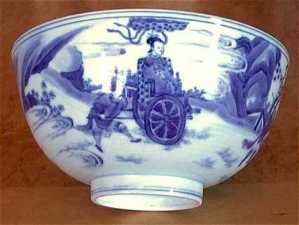
During the first decades of the Qing dynasty which was foremost established around the capital Beijing, in the North, not much if any porcelain was made for the court since the porcelain factory was located in the far from completely subdued South. This early period is therefore called the "transitional period" during which some remarkable good quality pieces was made for local businessmen, scholars and mandarins and for the export trade to Europe via the Dutch East India Company (VOC).
To the West, Chinese porcelain had first arrived with the Spanish and Portuguese explorers in the 16th century, at the end of the Ming Dynasty (1368-1644). With the Dutch and British Trade Empires in the 17th and 18th centuries, Chinese and Japanese porcelain entered the homes and palaces of the aristocracy and merchants alike, to consolidate their power and prove their supreme status.
The Qing Dynasty (1644-1911) which followed immediately after the Ming, is by many seen as the most successful of all the Chinese dynasties during the last two millennia. If we look at the period ruled by the three early emperors, Kangxi, Yongzheng and Qianlong this might be true but the disastrous ending from the mid 19th century and onwards indeed takes away some of the luster.
But the Qing dynasty as a family was begun earlier then that. The dynasty was founded in 1616, by Nurhaci, Jurchen chieftain of Later Jin, founder of Qing Dynasty (1559 - 1626) under the reign name of Tianming. his son Hong Taiji (28 November 1592 – 21 September 1643), also rendered as Huang Taiji and sometimes referred to as Abahai in Western literature, also known by his temple name as the Emperor Taizong of Qing, was the second khan of the Later Jin dynasty and the founding emperor of the Qing dynasty, Tiancong (1627-1636) and Chongde (1636-43). From the Shunzhi period and onwards only the reign names are used when referring to the periods.
During the last period Aixinjueluo Puyi actually ascended the throne in 1908 while the "Xuantong" reign is counted as started 1909. During the latter part of the Qing dynasty the Empress Dowager Cixi (Born 1835), who became dowager on the death of her husband, Xianfeng, in 1861, exerted a considerable influence on the Late Qing court until she died in 1908.
The reign names (nianhao) are different from the personal name of the emperor and it is this reign name we find on the bases of the Imperial porcelains of the period, not the name of the Emperor himself which we rarely don't even keep track of. To get on with the storyDespite that the Chinese capital Beijing had fallen into the hands of the Manchus, southern China was not completely under Manchu control before 1683. The resistance continued under a number of Ming dynasty princes and because of the strong loyalty towards the Ming, the Qing court were not able to order any "Imperial" porcelain from Jingdezhen in the southern Jiangxi province before about 1683.
This early period is therefore called the "transitional period" during which some remarkable good quality pieces was made for Scholars and Mandarins, and some for export to Japan and Europe via the Dutch East India Company (VOC). The best defines a period called high transition and some pieces from this period features very artistically applied washes of underglaze blue and some even the very difficult underglaze red made from copper oxide.
The decorations show a spontaneous, naturalistic style, the subjects often taken from book illustrations and prints. A vertical cloud often occurs as a divider in the decoration. Borders of thin lines incised near the top and foot rims and a clear blue color on a very white paste are characteristic features. Export porcelains intended for the Japanese market makes up another characteristic group during this period and are often of very special designs. Unglazed bases is a typical feature of this period but is no rule.
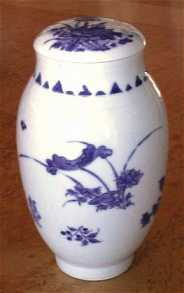
High quality Transitional / Early Kangxi game markers jar.
Characterized by Imperial pieces and Export porcelain of extremely high quality, both in paste and the blue pigments characterized the late 17th and early 18th centuries. The earlier "Transitional Period" designs gradually evolved into classic styles as kilns once again came under Imperial control. Foot rings are carefully treated and mostly seems to be polished or rounded off before glazing. For another example of Kangxi period porcelain, see: "Dragoneer Jar" from the collection of August the Strong of Saxony.
Ex James Keiller Coll. [More info here]

Buckledish. Chinese export porcelain, Kangxi period 1662-1722. The "buckle dish" shape in Chinese export porcelain is a fascinating form. Its origins are somewhat debated among scholars and historians. The design of the lobed edges does suggest a possible influence from metalwork. The lobed, scalloped edges of the buckle dish resemble designs commonly found in European silverware from the same period. European silversmiths often created ornate, multi-lobed dishes and platters, which could have been replicated in porcelain by Chinese artisans for export purposes.
The Kangxi period (1662-1722) lasted for sixty years and can be divided in four period.
The first Kangxi period 1662-1681
The Kangxi emperor ascended the throne at the age of eight in 1661 after the passing of his father the Shunzhi emperor. His mother passed away one year later. Initially, four regents were appointed to manage the state affairs due to Kangxi’s young age. Grand Empress Dowager Xiaozhuang whom he held in great respect throughout his life also exerted substantial influence in court politics and was a guiding figure for the young emperor. As Kangxi grew older, he began to assert his authority. By 1669, he successfully removed the chief regent, Oboi, consolidating his control over the empire.
In 1680, during the nineteenth year of the Kangxi reign, an imperial order was given to send four supervisors to Jingdezhen to oversee a large-scale production of imperial porcelain. The designer responsible for the ceramic forms and patterns of this massive imperial order was Liu Yuan (ca. 1641-91). Liu Yuan presented several hundred porcelain designs, drawing inspiration from both ancient and contemporary examples while incorporating his innovative ideas. His designs led to the creation of porcelain wares that were considered superior to those of the preceding Ming dynasty.
The four supervisors, who arrived in Jingdezhen in 1681, were:
The second Kangxi period (1682-1688)
This effort aimed to produce high-quality porcelain pieces for the imperial court and lasted until 1688, at which time also the Grand Empress Dowager Xiaozhuang passed away.
1644: The Qing dynasty begins after the Qing conquest of the Ming regime.
1654-1660: The Department of Works transmits edicts to Jingdezhen to produce massive dragon bowls and porcelain architectural panels. However, after several failed attempts, production is not pursued further.
1654: Xuanye (1654–1722), later known as the Kangxi Emperor, is born. He is the third son of the Shunzhi Emperor and ascends to the throne at a young age.
1661: Xuanye ascends the throne as the Kangxi Emperor at the age of eight. This marks the beginning of his 61-year reign (1661–1722), the longest in the history of dynastic China. His mother passes away one year later, and he is raised by Grand Empress Dowager Xiaozhuang (1613–1688), who plays a crucial role in his upbringing and governance.
1662: The Kangxi Emperor is officially recognized as the ruler, starting his long and influential reign.
1671: The Kangxi Emperor commissions the production of sacrificial vessels and other ritual pieces, probably for the mausoleum of his father. However, production does not start until three years later due to attacks from rebel armies.
1674: Production is delayed as rebel armies from the Three Feudatories attack Jiangxi province. Jingdezhen is sacked, and kilns and workshops are burnt and destroyed.
1677: The town of Jingdezhen is pacified, and ceramic production resumes. Grand-scale commissions from the Imperial Household Department in Beijing are accepted.
1679: Liu Yuan (ca. 1641–ca. 1691), a noted designer, returns to Beijing and contributes several hundred porcelain designs to the Imperial Porcelain Factory in Jingdezhen. His designs are known for their innovative and elegant styles.
1680: An imperial order is given to send four supervisors to Jingdezhen to oversee a large-scale production of imperial porcelain.
1681: Four supervisors, Xu Tingbo (Director), Li Yanxi (Secretary of the Storage Office of the Imperial Household Department), Zang Yingxuan (Director), and Che Erde (a clerk in the Bureau of Forestry and Crafts, Ministry of Works), arrive in Jingdezhen to oversee production. The production of this order continues until 1688.
1681: Lang Tingji (1663–1715) begins his official career as Sub-prefect of Jiangning, Jiangsu province. He later becomes an influential official and is known for his interest in local pottery processes.
1681-1688: During this period, the production of Zang wares, designed by Liu Yuan, takes place. These wares are noted for their high quality and artistic innovation.
1688: The production of the large-scale imperial porcelain order is terminated. Grand Empress Dowager Xiaozhuang passes away, matching the timing of the Zang wares' emergence. Kangxi deeply respects Xiaozhuang, and her death marks a significant moment in his reign.
1705: Lang Tingji is appointed Governor of Jiangxi, where he remains until 1712. His lengthy term of service and personal interest in pottery lead to his association with a special type of copper-red ware known as "Lang ware."
Lang Tingji (1663–1715) began his official career in 1681 as Sub-prefect of Jiangning, Jiangsu province. In 1705, he was appointed Governor of Jiangxi, a position he held until 1712. During his tenure, he showed a significant interest in local pottery processes, which led to his association with a special type of copper-red ware known as "Lang ware." However, recent scholarship suggests that Lang ware, characterized by its unique copper-red glaze, was likely produced long after Lang Tingji's tenure in Jiangxi. This indicates that while Lang Tingji was influential in the development and supervision of porcelain production, the actual creation of Lang ware extended beyond his direct involvement in the region.
Lang Tingji’s lengthy term of service as Governor of Jiangxi and nearby provinces, and his personal interest in the local pottery process, have led him to be associated with a special type of copper-red ware (so-called “Lang ware”) of the late 17th and the 18th century. However, as this group of “Lang ware” shows in variations in form, glaze, foot formation and the colour of the patchy glaze on the foot, recent scholarship has suggested that the production period of “Lang ware” might have been extended beyond the brief eight-year tenure of Lang in Jiangxi, so the attribution of this group of sang-de-boeuf ware to Lang would have been a misnomer. Making use of the descriptions recorded in poetry and literary records by contemporaries of Lang, scholars have found that the characteristics of true Langyao ware were faithful copies of Ming classical wares of the Xuande and Chenghua (1465–1487) reigns, consisting of monochromes and blue and whites. Also, the identification of Lang’s private studio mark, “Yuchi Chunyi Tang”, has helped to pinpoint the true features of these Lang wares.
1712: Lang Tingji is made concurrently Acting Governor General of Jiangsu and Anhui, then promoted to Director General of Grain Transport later that year. He moves to Jiangning (Nanjing), Jiangsu province.
1713: Before leaving Jiangxi, Lang Tingji supervises the tribute porcelain for the sixtieth imperial birthday celebration of the Kangxi Emperor.
1715: Lang Tingji dies in Huai’an, Jiangsu province. His contributions to pottery and his administrative roles are remembered.
1722: The Kangxi Emperor dies, and the Yongzheng Emperor ascends the throne. Yongzheng is suspicious of the An family, who are involved in imperial porcelain production.
Based on historical records, during the interim period between the Kangxi and Yongzheng reigns, the people responsible for the Imperial Porcelain Factory at Jingdezhen were members of the An family: An Chi (1683–after 1742) and his father, An Shangyi.3 An Chi was a connoisseur of traditional calligraphy and painting, and his catalogue, Moyuan Leiguan, is an indispensable reference tool for all students, scholars and collectors of classical Chinese painting and calligraphy (17). Originally from Korea and hailing from a famous salt merchant family, An Shangyi was ordered in the latter years of the Kangxi reign to send his family members to Jingdezhen to supervise imperial porcelain production. However, during this period, the old Kangxi emperor was indecisive in the appointment of his heir apparent; the appointment and abolishment of the designated crown prince became a frequent occurrence, and many imperial family members conspired to seize the throne. After his enthronement in 1722, Emperor Yongzheng bore resentment against his brothers and their lackeys, who had attempted to seize power. An Shangyi was the servant of Ming Zhu (1635–1708), whose son, Kui Shu (1674?–1717), was a supporter of two of Yongzheng’s brother-contenders. After ascending the throne, Yongzheng was, thus, suspicious of the An family. In a vermillion rescript, Yongzheng stated that An and his family “refused to submit to authority”, specifying their use of the former Chenghua imperial reign mark instead of the legitimate Yongzheng base mark when firing imperial porcelain in Jingdezhen. The real reason this was done was most likely a continuation of the long custom of imitating the famed Ming ware, which had been practised in the late Ming and in the early Kangxi period. Yet, Emperor Yongzheng regarded it as disrespectful to himself, the newly enthroned emperor. An Shangyi, An Chi and their family were subsequently dismissed from their positions in 1727.
1727: An Shangyi and his son, An Chi (1683–after 1742), along with their family, are dismissed from their positions by Emperor Yongzheng for their perceived disloyalty. An Chi is known for his connoisseurship in traditional calligraphy and painting, and his catalogue, Moyuan Leiguan, is a valuable reference for classical Chinese art.
Ascending the throne at the age of 45 he was as his grandfather a devout Zen Buddhist and turned out to be an able ruler. The new Emperor took an interest in the imperial porcelain factory, and some of the finest porcelain ever made was produced during his reign. In 1726 the Yongzheng emperor appointed Nian Xiyao as administrator of Jingdezhen, who also personally supervised the manufacture of the porcelain destined for the Imperial Court. The porcelain is very delicate and often in the style of the Ming emperor Chenghua. After 1730 a marked decrease in the production of blue and white wares could be noticed due to the rising popularity of polychrome enamels. A "Qing" style is emerging, which could at best be described as "Flowery".
The 18th century saw an immense volume of Chinese porcelain exported to the West, driven by the high demand for these exquisite wares. The most popular decorations included armorial porcelain, Famille Rose and Famille Verte, blue and white, and Chinese Imari. Thanks to the managerial skills and innovations of Tang Ying (Chinese: 唐英; 1682–1756) and Lang Tingji (1663–1715), governor of Jiangxi province and supervisor of the imperial kilns from 1705 to 1712, the quality of porcelain produced during the Qianlong period reached new heights, influencing both domestic and export markets profoundly.
The Qianlong period (1736-1795) was the time during which the porcelain trade between China and the West reached its high point. Thousands of armorial porcelain services were ordered by European noble and wealthy families, despite the fact that true porcelain had been possible to make in Europe since 1708. However, European manufacturers could not match the quantities or prices of chine de commande from China. It is believed that millions of pieces were ordered from China every year during the 18th century.
Quantifying the exact amount of porcelain ordered from China in the 18th century is not possible due to the varying records of different East India Companies. However, it is known that The Dutch East India Company (VOC) was particularly active in the trade, importing hundreds of thousands of pieces annually. The British East India Company also played a significant role, with large consignments being shipped to England, where the demand for Chinese porcelain was exceptionally high. Other countries, including France, Portugal, and Sweden, also had their East India Companies importing significant quantities of porcelain.
Lang Tingji served as the director of the imperial porcelain factory before Tang Ying. He is credited with improving the quality and consistency of porcelain production, which set the stage for Tang Ying's later enhancements.
As a brilliant manager and potter, Tang Ying was instrumental in perfecting the techniques of porcelain production at the Jingdezhen kilns during the Qianlong period. His innovations in glaze and decoration significantly contributed to the quality and beauty of both imperial and export porcelain.
All in all porcelain during the Qianlong period was widely different, stretching the limits of what was possibly to make. Imitating everything previously done and all kinds of materials (not in blue and white, though but in enamels - imitating wood, bronze, anything.) Skilled craftsmen produced magnificent copies of earlier masterpieces. Overall floral scroll designs characterize the wares of this reign. The paste is dead white. Chinese porcelain is now becoming a standard article in wide use in Europe. Huge amounts of dinnerware (dishes, soup tureens, huge flats dishes, salad bowls, etc.) are exported to Europe in shapes and with decorations designed in Europe, often in a "Chinese" style - called Chinoiserie.
Armorial Porcelain:
Famille Rose and Famille Verte:
Blue and White Porcelain:
Chinese Imari:
Export Figures and Models:
By the end of the 18th century and the beginning of the 19th century porcelain is becoming less expensive to make in Europe than in China. Transfer printing has been introduced in Europe of porcelain designs which makes it very difficult nigh impossibly to compete, for the Chinese who are hand painting everything. Export to Europe decreases. Foot rims are generally coarse and unglazed, although a more delicate foot ring occurs on fine pieces.
In the 19th century and later, Chinese and Japanese porcelain spread throughout society as a source of inspiration, reflecting a dream of an ideal world.
The 19th century is traditionally regarded as a down period for Chinese porcelain but exceptions occurs. When North America began sending ships of its own to trade with China in the early 1800s, they entered into a business that since long had found its form. A limited number of standard patterns made up the majority of the Chinese porcelain wares that was exported at this time. The main market was North America, during the full length of the 19th century. Popular patterns includes a blue and white "willow pattern" called "Nanking" with pagodas in a river landscape and an enamel pattern with mostly green flowers end mandarins within panels, called Rose Medallion.
First class Imperial porcelain is developed in classical Chinese taste. It is nowadays getting better known and finally receiving its well-deserved admiration. During the middle and later part of the 18th century China is torn by famines, war and general unrest which problems naturally also causes problems for the porcelain industry. Blue and white decorated porcelain becomes comparatively uncommon during the 19th century, maybe because of the fighting that hits also Jingdezhen and its kilns in 1853. Production was curtailed and the Imperial factory were not rebuilt until 1864. On the whole not much porcelain appears to have been made at all during the third quarter of the 19th century.

Dish, Guangxu period 1875-1908. Decorated with two five clawed dragons chasing the Imperial pearl , in the center a stylized shou (long life) character surrounded by five "fu" (happiness) bats, symbolizing "The Five Happiness's". The mark on the base of the dish reads "光緒甲午年製" (Guāngxù jiǎwǔ nián zhì), which translates to "Made in the Jiawu year of the Guangxu period." The Jiawu year corresponds to 1894 in the Gregorian calendar. Given the imperial motifs and the significance of the Jiawu year, this dish was likely made to commemorate an important occasion such as a significant birthday or event for a high-ranking official or member of the imperial family. Empress Dowager Cixi, a highly influential figure during the Guangxu period, would have had the authority and resources to commission such high-quality, ornate pieces. The presence of imperial symbols like the five-clawed dragon indicates that this dish was likely intended for someone of very high status within the imperial court. Considering the year 1894 and the potential for the dish to be made for a significant event, it is possible that it was commissioned for Empress Dowager Cixi herself, despite her 60th birthday being in 1895. This aligns with her known penchant for lavish and elaborate displays of wealth and power.
Increased wealth, immigration and improved world trade involving South East Asia and far away markets such as North America improves Chinese economy and from early Guangxu period Jingdezhen appears to try to make up for lost business. Enameled designs on late 19th century and early 20th century pieces for the common men are often carelessly executed however the Imperial kiln and their subcontractors appears as skilled as ever.
From the end of the 19th century an artistic, scholarly style of decoration appears in muted enamels, inspired by traditional silk paintings, called qian jiang. The Imperial court under the Empress Dowager Cixi introduces a new decorative style incorporating very large flowers.
A common export decoration from the Guangxu (1875-1908) period and later occurs in imitating crackled Ge glaze, warrior type figures and with a ring etched in brown around the base or the shoulder. The bases usually displays a roughly incised reign mark, etched on a brown square.
As late as 1920 a visitor to Jingdezhen reports that the largest export customer of porcelain is a North American company.
The 20th century witnessed as dramatic events as any previous reign and what porcelain that was made was as diverse as ever.
In 1911 the revolution led by Dr. Sun Yat-sen ended the rule of the Qing Dynasty. The Imperial family rule that had existed in China for 2,000 years came to an end, and the provisional government of the Republic of China was founded. During this period a last attempt to establish a new dynasty led to a temporary revival of the potters art when substantial funds was spent of developing a new Imperial ware for Yuan Shikai under the name of Hongxian (1915-16). The Song dynasty was first considered as the best model for the porcelains of the new era, why very likely some incredibly good copies of the Song classical (Ge, Guan, Ru, Ding and Jun) wares date from this period.
It was finally decided that the porcelain of theYongzheng period would suit as the best model, why also some very good early Qing style enameled wares dates to this period. Regarding the genuine pieces that was actually made during this period, I personally feel that is seen from a set of entirely new shapes that distinguish the real Imperial porcelain from this short period from the much debated similar pieces that carries the marks of the period.
In 1937-45 Japan occupied a large part of China which was followed by a war of resistance against Japan. This was a troubled period for the Chinese people which naturally affected the ceramic industry. From pieces that would fit to this period one can recognize attempts to start up a more industrial mass production. Experiments with using coal for firing porcelain is made. Some cooperation between Chinese and Japanese potteries also seems to have occurred.
In 1949 the People's Republic of China was founded, with Mao Zedong as chairman of the Central People's Government after which a much needed recovery period takes place between 1950 to 1956. The modern ceramic production could be said to have started by 1949 by the introduction of more efficient kilns fired by crude oil and transfer printed overglaze decoration. I believe lots of influences reached China from Russia during this time. Some heavily over decorated and bombastic pieces dates to this period.
Between 1956 to 1966 heavy investments were made in new and basic industries. Mass production and better control gives higher quality. Very few attempts are made to artistically vitalize the production that still runs in old tracks however technically very impressive pieces are made for official presentations.
The disastrous "cultural revolution," lasted for ten years from May 1966 to October 1976. Most activities on all levels was halted and nothing much was produced.
In 1978 China instituted a policy of reform and opening to the outside world with the focus to modernization centered around the economy "with Chinese characteristics". The ceramic production could from now on be considered very modern with artistic and mass production side by side. See also my article "A Visit to Jingdezhen" on this.
What books to recommend for Chinese Porcelain of the Qing Dynasty depends if you want to study the best that could be made (Imperial), what was made and exported to the West (Export Porcelain) or the popular wares that was made for export to the poorest of farmers and the working class all over Asia in particular from mid 19th century and later. All is technically "Chinese porcelain" and most was in fact made in Jingdezhen. But there and then stops the similarities. A reliable and traditional classic is Soame Jenyns, Later Chinese Porcelain for the "good" Chinese taste pieces. For export porcelain Jean McClure Mudge, Chinese Export Porcelain in North America or Geoffery A Godden, Oriental Export Market Porcelain and its influence on European Wares might be good starting points. They won't hurt to have anyway. For the best of the best, search for anything with "David Howard" as the or at least among the authors. Finally the best overall book there is on Chinese ceramics is in my view He Li, Chinese Ceramics which covers everything, including the Qing Dynasty. That is a good one too that you will never regret buying. As a general rule, you should spend at least 10 percent out of the amount you plan to spend on porcelain, on books. And ideally you should always buy the books first. After ten years, please send me the amount of money you feel you have saved by following this one advice and I'll become a rich man.
Jan-Erik Nilsson
 Back to Gotheborg.com Home Page