
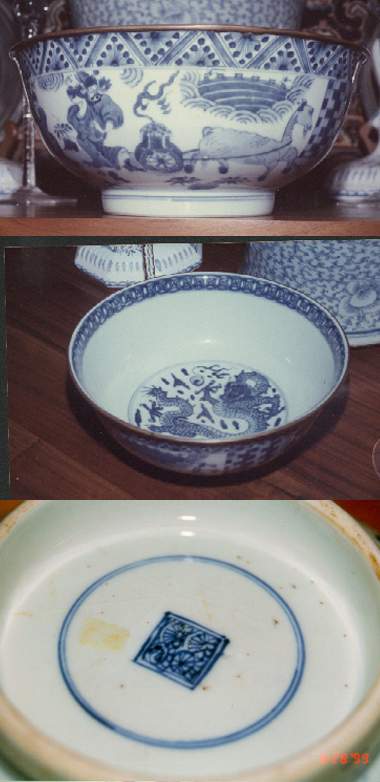
 I have a blue and white porcelain bowl that I acquired in France about 17 years ago.
I have shown it to several experts in Asian porcelain and have been given some very interesting opinions.
However, all have agreed that the bowl is somewhat of a mystery, and opinions have been diverse.
The bowl is about 8 and one half inches in diameter and has a tarnished silver rim.
Your bowl in unusual but not that big a mystery. First of all, it is Chinese, despite the fact that is has several features that from a picture could make you think of Japan, such as the top outside border which is unusual, and the inside border closest to the rim, which is in a Kangxi period style often associated with Japanese taste.
An immediate thought is that it could have been made either during the closing decades of the 19th century or during the late 17th to early 18th century. I will give you the arguments for both, then the quality of the glaze as felt when handled will tell you which of the two possibilities are the correct.
The mark on the base is typical of the late Kangxi period and occurs I believe also for some time into the Yongzheng period. The Yongzheng period is however so short (1723-35) that is it not possible for me to tell the difference between something made a few years on each side of 1722, but there you are anyway. I call this a "brocade mark", which might be wrong of course but I use that name anyway since it somehow identifies it. It is fairly common on pieces dating to the first decades of the 18th century but I have seen it on blue and white porcelain that I have felt was made well into the 20th century, so this alone is not conclusive.
The foot rim and the white glazed base with the small black pinholes are early 18th century in style but are not impossibly at a later date - i.e. the Guangxu period - so this is not conclusive either.
The decoration is quite unusual and seems to be a man in and elaborate dress standing next to or following a cart pulled by a goat.
The locality of the scene is indicated by the presence of a "Wall surrounded by clouds" as seen behind the cart. The drawing of this wall - maybe the Great Wall - seems to be simplified and based on earlier sources i.e. the Transitional/Kangxi period, rather than actually belonging to it. The motif as such is almost overly explicit of someone bringing tribute to the emperor especially if we consider the proximity of the Great Wall to Beijing, which was the capital of China during the entire possible period of this bowl.
The confusing feature on this bowl is however the metal clad rim which is very common on Chinese porcelain in Thailand. This feature feels very uncomfortable on such a large bowl like this, except maybe covering a damage or - alluding to an earlier time when the rims of food and tea bowls were unglazed out of necessity and therefore got clad in copper or silver to be more pleasing to the lips of the user.
The problem is that a metal clad rim such as this, together with the Qing style dragon, are common features often seen together on a group of pieces all made during the latter part of the 19th century.
From the style of the bowl, the mark, the soft blue cobalt and what I can see of the brushwork, I would like to suggest that this bowl however is from the late Kangxi period or immediately thereafter.
To me it is in this rather interesting category all characteristics of your bowl would fit in quite comfortable. However, in this case only handling can tell from which period this bowl really is, and this you could do yourself.
If the glaze is so soft and glossy when handled - that it almost feel unctuous to the touch - then bowl belongs to this earlier period.
Jan-Erik Nilsson
Reply and comments:
Thank you again for your additional contributions to this discussion of the bowl. I find your thoughts intriguing and thoughtful. I guess I had always assumed (probably by mistake) that the rim was added to conceal some sort of damage or imperfection (is the term fritting? ) to the rim - there is one place along the rim - I think it is in one of the pictures but the picture may not be clear-that appears to be a place where there is a small chip repaired with some dark brown almost resin like substance that is mostly covered by the rim but extends just slightly below the rim. I guess what I am seeing could just be dirt but it does appear to be a chip under neath.
Some people have called the rim tarnished silver some have said copper-would it matter which in classifying the bowl and how could I tell.? Would I damage the rim if I touched it with silver polish to see if the color changes?
I will certainly take your suggestion and look at the bowl more carefully as compared to the decorative jar, which I know to be 19th century. I also have Mr Allens book on identifying later porcelain. Would it be helpful for me to look for some of the characteristics that he suggests as typical of non-imperial and export porcelain of that period?
 Back to Gotheborg.com Home Page